MRI magnets and cryogenic services
MRI ramp-up and ramp-down: magnetic field, current, power supply and safety
Lowering an MRI field does not mean removing helium. It means reducing the magnet’s persistent current in a controlled way while managing energy, leads, cryogenics and safety.
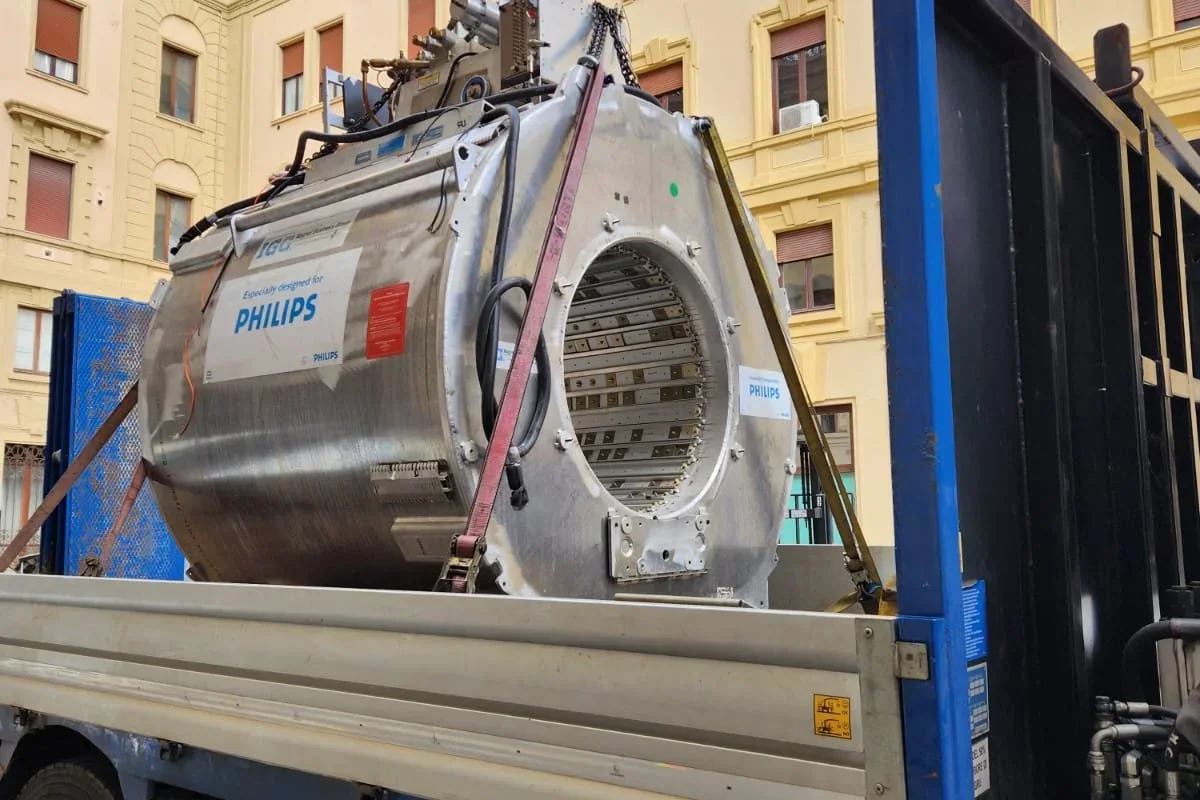
When people hear about ramping an MRI magnet up or down, they often imagine a large switch that turns the magnet on or off. The reality is different. The field of a superconducting MRI comes from current circulating in the magnet windings, and once established that current can continue even when no external power supply remains connected.
Changing the field therefore means controlling magnet current. Ramp-up progressively brings it to the required value; ramp-down reduces it in a controlled manner towards a lower field or zero. Helium is essential, but it does not create the magnetic field and is not removed to switch the magnet off correctly.
These concepts matter beyond the engineering team. They help imaging-centre owners, facility managers and project leaders understand what happens during first energisation, deinstallation or recommissioning, and why magnet work needs the same level of planning as physical system movement.
The key idea: magnetic field comes from current
The MRI main magnet contains windings designed to generate an extremely uniform static field. The field, known as B0, is measured in tesla. The current passing through the windings is measured in amperes.
Put simply, as current increases, field strength increases. The precise relationship between amperes and tesla depends on coil design: geometry, turn count, materials and active shielding make each magnet family different.
It is therefore wrong to assume that every 1.5 T or 3 T MRI operates at the same current. Many clinical magnets use currents in the hundreds of amperes, but the exact figure belongs to that magnet. Technical documentation expresses the relationship through a system-specific calibration factor.
NIST publishes examples of superconducting magnets with different amperes-per-tesla ratios and inductances. They illustrate why tesla and amperes describe connected, but different, properties.
What helium actually does
Helium does not power the magnetic field. In a conventional superconducting magnet it keeps the windings cold enough for current to circulate with extremely little electrical resistance.
The distinction can be summarised as follows:
- current in the windings generates the field;
- helium and refrigeration maintain superconducting conditions;
- the cryostat limits heat entering from the environment;
- the ramping power supply changes current when the field needs to rise or fall.
This is why an MRI can remain fully magnetic while its console, gradients and other electronics are switched off. Powering down the scanner is not the same as removing the field.
Why the current keeps circulating
After ramp-up, many clinical magnets operate in persistent mode. Current remains closed inside the superconducting circuit and continues to circulate for a very long time without continuous input from an external supply.
A component known as the persistent switch permits the controlled transition from externally supplied current to current trapped within the magnet. It is not an ordinary mechanical switch, but part of the cryogenic superconducting circuit.
Persistent mode makes the magnet efficient and stable, but it also creates a common misconception: disconnecting the MRI’s normal electrical supply does not interrupt persistent current. The static field must be treated as present until its state has been changed and verified by competent personnel.
The Siemens Healthineers Academy explains superconducting magnets and ramping, while NIST describes the persistent-switch principle.
What happens during ramp-up
Ramp-up brings the magnet to its operating field. An external supply progressively transfers current and energy to the windings. As amperes increase, the magnetic field increases too.
The aim is not to reach the final value as quickly as possible. A magnet is highly inductive and opposes sudden changes in current. Its ramp profile must remain within the electrical, thermal and cryogenic limits of that exact configuration.
The parameters defined by the manufacturer are monitored throughout the activity. They involve more than current and voltage: the magnet, connections, persistent switch and cryogenic system all form part of the same process. Once the intended current is stable, the magnet can return to persistent mode and the service supply no longer has to sustain the field.
For the customer, the result is not merely a “switched-on magnet”. It is a system brought to the correct, stable and documented field, ready for the subsequent functional and quality checks.
What happens during ramp-down
Ramp-down is the reverse process. The current circulating in the magnet is made accessible to the external ramping system and progressively reduced. As amperes decrease, the field decreases.
The stored energy does not simply disappear. It is returned or dissipated through the circuits intended for that magnet. This is fundamentally different from a quench, where energy turns into heat very rapidly inside the magnet system.
At completion, magnet condition should not be inferred from a screen alone. Residual field and system state are verified and recorded as part of the work. This is especially important when ramp-down precedes deinstallation.
MPSU 3600, “MPS3600” and Philips ARU
Dedicated ramping equipment is used in MRI field service. Well-known names include the MPSU 3600, also commonly referred to as MPS3600, and the Philips ARU.
MPSU 3600 means Magnet Power Supply Unit: a service power supply designed to manage current while compatible magnets are ramped. ARU is the familiar designation for a Philips unit used in the same broad service area on compatible configurations.
They are not ordinary bench supplies and they are not universal tools. Owning a ramping unit does not mean it can be connected to any MRI. Different magnets may require different interfaces, cables, protection, software and ramp profiles.
Expertise therefore involves more than having the hardware. It means correctly matching:
- magnet model and configuration;
- ramping unit and compatible accessories;
- applicable technical documentation;
- cryogenic condition and site constraints;
- monitoring maintained during the activity;
- final verification and records.
The term Magnet Power Supply Unit also appears in Siemens patent documentation concerning MRI magnet ramping, including EP3739353A1. For a Philips ARU, the complete designation and compatibility should be confirmed from the label and OEM documentation of the particular unit.
Why current leads matter
Current leads, usually shortened to leads, form the high-current connection between the external supply and magnet circuit. They have to carry hundreds of amperes from room temperature into a cryogenic system while introducing as little heat as possible.
This is a delicate balance. Even a very small resistance can produce heat when current is high. Integrity, compatibility, cooling and connection quality are therefore central to the work, not minor cabling details.
Some configurations use temporary or retractable current leads; others use permanent designs. Once again, there is no single architecture for every MRI. Knowledge of the magnet comes before use of the tool.
Why fixed MRI systems are usually ramped down for deinstallation
A superconducting MRI remains at field even when it appears switched off. Deinstallation, however, brings tools, trolleys, lifting structures and personnel into a room in ways that do not occur during normal clinical use. Access, shielding and the surrounding environment may also change.
For fixed-system deinstallations and relocations, where required by the manufacturer’s plan, ramp-down allows the magnet to be managed out of field and helps to:
- reduce ferromagnetic attraction at source;
- make dismantling and movement more controllable;
- put the magnet into the required transport condition;
- verify and document its state before the logistics phase;
- coordinate magnetic, cryogenic and mechanical work correctly.
The MHRA MRI safety guidelines explain that the static field extends beyond the system covers and can turn ferromagnetic objects into projectiles. They also advise consulting the manufacturer for safe decommissioning of the specific product.
Some mobile configurations are designed and certified for transport while energised. This is another reason not to apply a generic rule. The transport state of a fixed MRI must come from its model, documentation and movement plan, not habit.
The myth: “helium must be removed to lower the field”
No. The field is lowered by reducing current in the windings. Removing helium takes away essential cooling; it does not command the field to fall correctly.
Uncontrolled helium loss or removal can lead to warming, heavy boil-off and loss of superconductivity. In other words, it can turn a planned task into a cryogenic event with greater risk, cost and recovery time.
After a controlled ramp-down, a conventional magnet can remain cold and retain its helium inventory. Any later cryogen work depends on model, destination and transport method. It is another phase of the project.
Newer sealed architectures make the separation between field and helium even clearer. Philips describes controlled field reduction while helium remains inside the sealed BlueSeal circuit. The behaviour should not be generalised to conventional magnets, but the principle is clear: draining a magnet is not how ramp-down is performed.
Controlled ramp-down and quench are different events
Both can take a magnet out of field, but they are not equivalent.
During a controlled ramp-down, current and energy are reduced in the manner intended for the system. It is the planned option for service, deinstallation and other non-urgent conditions.
During a quench, part of the winding rapidly loses superconductivity. Current encounters resistance, energy becomes heat and, in conventional magnets, a large amount of helium can evaporate and be routed through the quench pipe.
A quench can occur spontaneously or be initiated in a genuine emergency under the facility’s procedures. It is not simply a faster version of a normal ramp-down. It may involve helium loss, additional inspection, extended downtime and, in some cases, damage.
Philips documentation explicitly distinguishes normal controlled field reduction from Emergency Magnet Off. The ACR Manual on MR Safety also recommends discussing an intentional controlled ramp-down with the manufacturer, where practical in a non-urgent situation, rather than performing a preventive quench.
What risks are managed during a ramp
Ramp-up and ramp-down are controlled activities, but not risk-free ones. Key areas include:
- current and stored energy: the magnet retains energy even when no external supply is connected;
- leads and connections: abnormal resistance can create heat at high current;
- rate of change: ramping too quickly can create stress and contribute to a quench;
- cryogenics: pressure, refrigeration and helium level must remain within acceptable conditions;
- changing magnetic field: the controlled field area changes during the work;
- compatibility: supply, leads, interfaces and configuration must belong to the same technical design;
- documentation: nominal current, profile and acceptance criteria cannot be copied from another magnet.
Quench risk is not merely theoretical. Siemens Healthineers lists it among the considerations during ramp-up and ramp-down in its information on magnet preventive maintenance. This does not mean quench is the normal outcome; it means preparation, experience and correct interpretation of the magnet’s behaviour matter.
What a well-planned intervention looks like
For the customer, good planning is visible before ramping begins. A service team should request precise magnet information, understand the purpose of the ramp, establish cryogenic condition, confirm equipment compatibility and coordinate with those responsible for the room, deinstallation and movement.
At completion, the following should be clear:
- the magnetic state achieved;
- the checks completed;
- any anomalies observed;
- the cryogenic condition of the system;
- what is permitted during the next phase;
- who assumes responsibility during movement, transport or recommissioning.
A power supply is a tool. The value of the service lies in connecting the magnet, equipment, safety and project objective correctly.
Frequently asked questions
Does switching off the MRI remove the magnetic field?
No. In persistent mode, current continues to circulate in the windings without the scanner’s normal electrical supply.
How many amperes are needed for 1.5 T or 3 T?
It depends on the magnet. There is no universal value; the current-to-field relationship is determined by the design and calibration of the specific coil.
Must helium be removed before ramp-down?
No. Ramp-down reduces current; helium keeps the magnet cold. Cryogen handling is a separate activity.
Is a quench a fast ramp-down?
No. Ramp-down is a controlled reduction of current. A quench is loss of superconductivity with rapid conversion of energy into heat.
Can an MRI be moved immediately after ramp-down?
Ramp-down is only one phase. Residual field, cryogenic condition, system safety and the lifting and transport plan must all be verified first.
Can an MPSU 3600 or Philips ARU be used on any magnet?
No. They are examples of ramping equipment. Compatibility, accessories and configuration must be confirmed for the exact magnet.
Support for MRI ramp-up, ramp-down and deinstallation
Ramping belongs within the complete project: magnet condition, cryogenics, access, venting, deinstallation or reinstallation, movement and destination. Treating these as unrelated jobs creates uncertainty at the most sensitive handover points.
Spinergy Medical can support the assessment and planning of magnet, cryogenic and deinstallation activities. Explore our MRI cryogenic services and MRI deinstallation service.
This article explains basic concepts and is not an operating procedure. MRI ramp-up and ramp-down must be performed only by qualified personnel using equipment and documentation approved for the specific magnet.
Technical sources
- Siemens Healthineers Academy — superconducting magnets and ramping
- NIST — Superconducting Magnet Systems
- MHRA — Safety Guidelines for Magnetic Resonance Imaging Equipment in Clinical Use
- Philips — BlueSeal magnet and EasySwitch
- ACR — Manual on MR Safety
- Siemens Healthineers — Magnet Preventive Maintenance