MRI cryogenic services
MRI cold head maintenance: protecting the magnet and helium reserve
The cold head removes heat from the cryostat and limits helium consumption. Understanding its function, maintenance needs and warning signs helps protect the magnet and operational continuity.
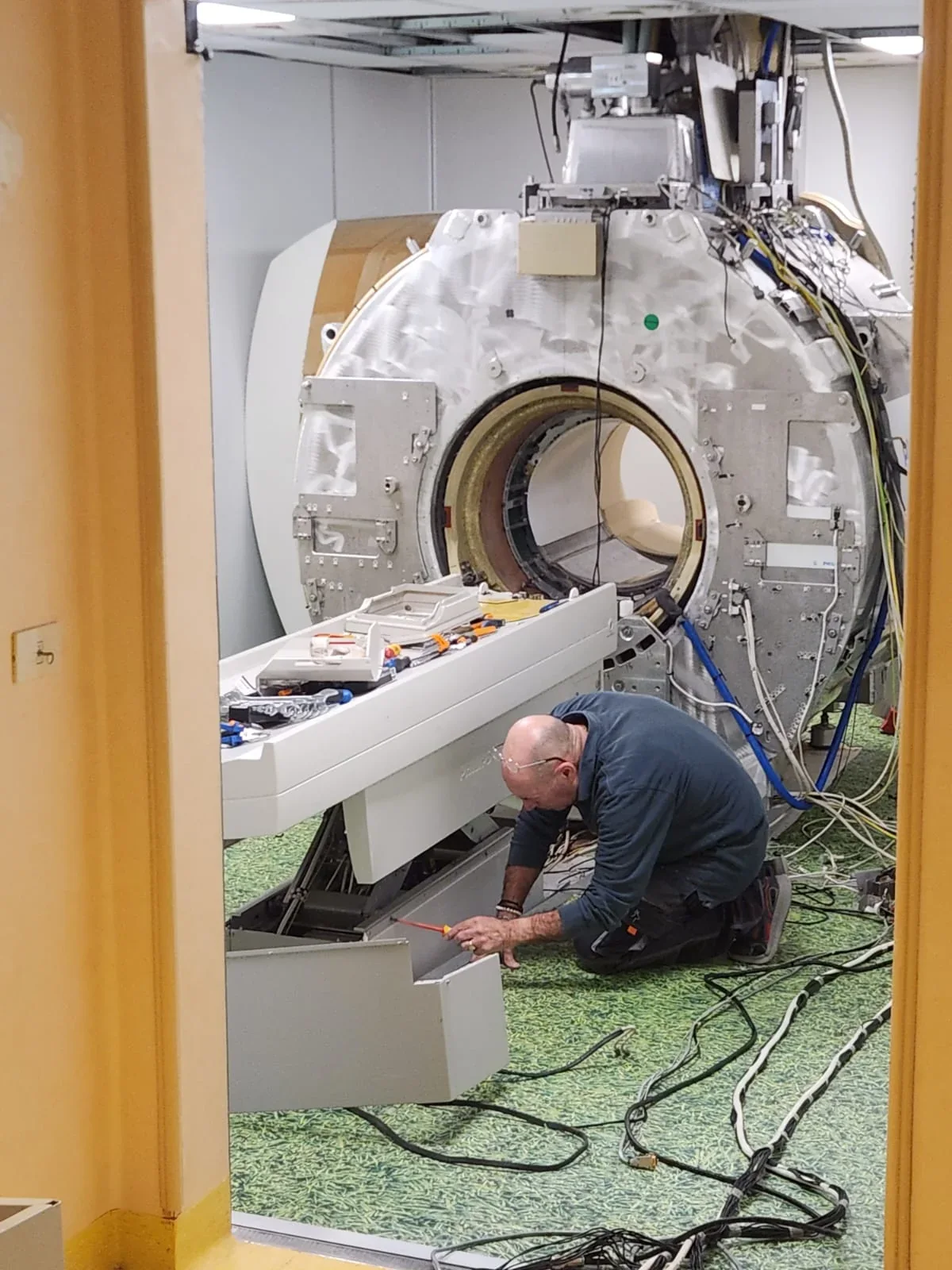
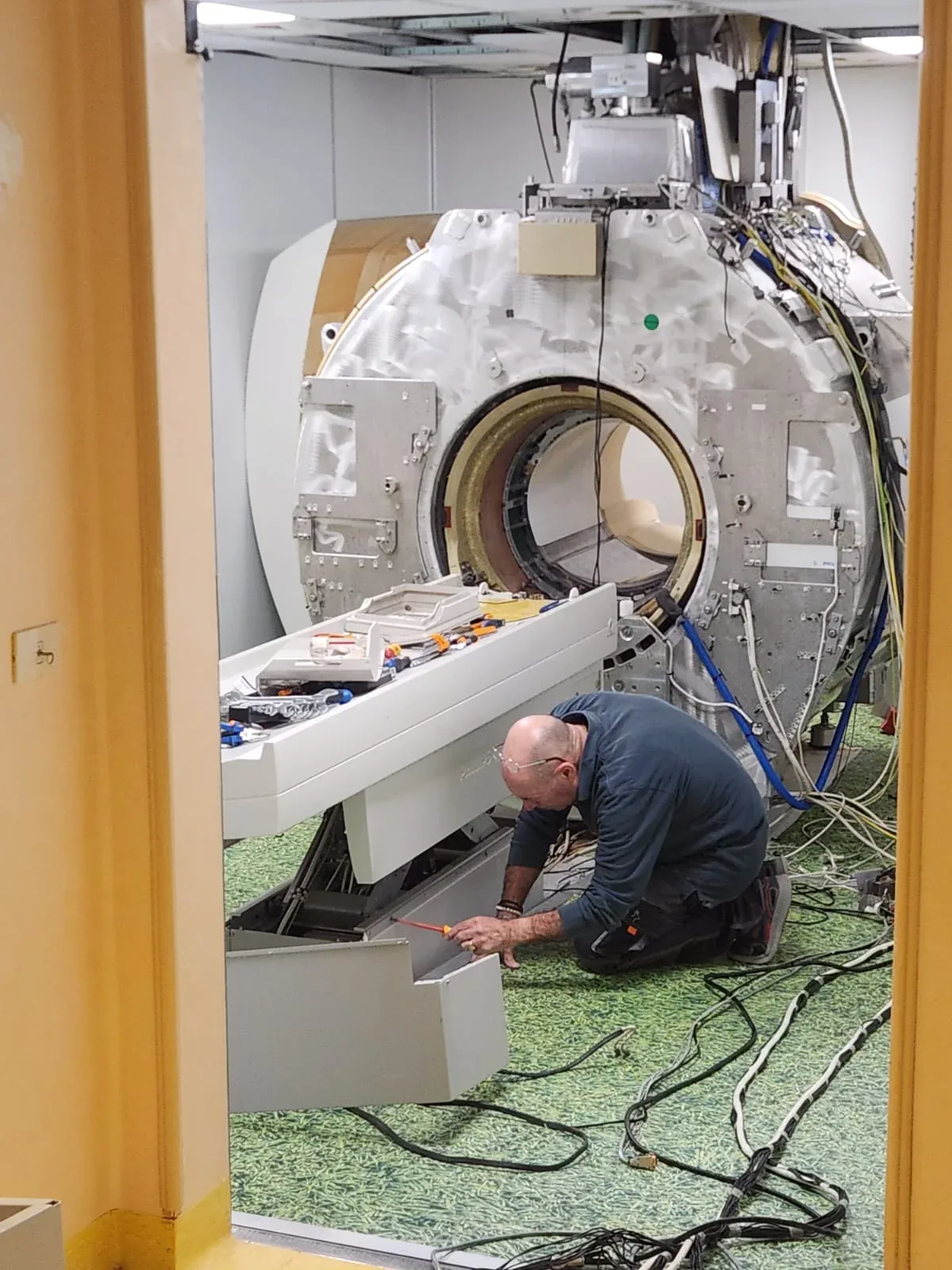
The cold head is one of the most important components in the cryogenic system of a superconducting MRI magnet. It works continuously to remove heat entering the cryostat and helps keep the magnet within the thermal conditions defined by its manufacturer.
When refrigeration capacity declines, the first effect is not necessarily an abrupt shutdown. The system will often lose efficiency progressively: temperatures change, helium evaporation increases, the liquid level may fall more quickly and the time available to plan an intervention becomes shorter. Cold head maintenance should therefore not begin only after a critical alarm.
This guide mainly concerns traditional superconducting MRI magnets with a liquid-helium bath. Newer sealed and low-helium magnets may have different architectures, controls and procedures. The documentation for the exact system, OEM instructions and assessment by qualified personnel always take precedence.
What is an MRI cold head?
The cold head is the cold expansion section of the cryorefrigerator. It works with an external compressor and gas lines that circulate helium in a closed loop. Repeated compression, expansion and regeneration cycles transfer heat from inside the cryostat to the external environment.
It is important not to confuse the two helium circuits:
- helium gas in the cryorefrigerator is the working fluid circulating between the compressor and cold head;
- helium contained in the cryostat cools the magnet in conventional systems;
- the two circuits work together through thermal exchange, but they are not the same circuit.
The US National Institute of Standards and Technology describes the principle of closed-cycle cryogenic refrigerators. In an MRI system, the exact configuration and thermal interfaces depend on the individual magnet design.
What does the cold head do?
Even a well-insulated cryostat receives a small, continuous amount of heat from its surroundings. Without active refrigeration, this heat load would eventually increase helium evaporation.
Depending on the magnet architecture, the cold head can perform two related functions:
- cool the thermal shields, intercepting some of the heat before it reaches the helium bath and reducing boil-off;
- recondense helium vapour, returning it to the liquid state in systems designed to operate close to zero boil-off.
It is not accurate to say that the cold head “cools the magnet on its own” in every MRI. In conventional systems, the liquid-helium bath is the primary thermal reserve for the windings. The cryorefrigerator, insulation, vacuum, thermal shields and venting system form an integrated assembly that must remain in the expected condition.
4 K and 10 K cold heads: what is the difference?
The terms 4 K and 10 K identify cryogenic performance classes. They do not describe MRI field strength, they are unrelated to the magnet’s tesla rating and they do not make one solution universally “better” than the other.
A 4 K cold head is designed to reach temperatures close to liquid helium. At atmospheric pressure, helium boils at approximately 4.2 kelvin. In a compatible system, a second stage capable of working in that range can recondense helium vapour. As one published example, the SHI RDK-408D2 is rated at 1 W of refrigeration at 4.2 K and has a stated minimum temperature below 3.5 K.
A 10 K cold head operates in a different thermal class. In MRI magnets using this architecture, it is typically associated with cooling thermal shields and reducing the heat load on the helium bath rather than direct recondensation at 4.2 K. The SHI RDK-408S, for example, states its second-stage refrigeration capacity at 10 K.
Three points help avoid common misunderstandings:
- “10 K” does not mean that the superconducting windings operate at 10 K: in a conventional magnet they remain in the cryogenic environment required by the design, close to liquid-helium temperature;
- minimum temperature and the temperature at which refrigeration capacity is rated are not the same measurement;
- 4 K and 10 K cold heads are not automatically interchangeable: interface, compressor, gas lines, controls, refrigeration capacity and thermal design must match the manufacturer-approved configuration.
How often should an MRI cold head be changed?
There is no single interval that applies to every MRI magnet. Saying that a cold head must be changed “every year” or “every two years” without knowing its model and service history can be misleading.
Manufacturers normally express maintenance intervals in operating hours. SHI specifications illustrate how much they can vary: the RDK-408D2 4 K and RDK-408S 10 K list 10,000 hours, the CH-210L 10 K 13,000 hours and the RP-182C2S 4 K pulse-tube model 20,000 hours. Under continuous operation these figures correspond approximately to fourteen, eighteen and twenty-seven months. They are published maintenance examples for specific products, not schedules to apply automatically to every MRI.
“Maintenance” also does not always mean complete replacement. Depending on the service programme for the component, the work may involve:
- cold head overhaul;
- replacement of wear components;
- refrigeration-performance and leak testing;
- exchange with an overhauled or new unit;
- coordinated checks of the compressor, gas lines, cooling water and magnet parameters.
SHI service information for medical applications describes performance tests and the replacement of wear components during overhaul. The correct schedule should therefore be defined from the exact model, operating hours, OEM manual, service history and parameter trends, not from the calendar alone.
Warning signs that can precede a failure
Loss of performance can be progressive. The indicators to be interpreted depend on the system, but conditions that warrant specialist assessment may include:
- cold head or cryostat temperatures moving outside their usual trend;
- increased helium consumption or boil-off;
- helium level falling faster than its historical trend;
- alarms relating to the cryorefrigerator, compressor or cooling circuit;
- noise or vibration differing from the usual behaviour;
- unusual frost or condensation around the magnet turret;
- repeated stops, restarts or loss of refrigeration availability;
- abnormal changes in parameters made available by the manufacturer.
A single indicator is not enough to diagnose the cause. Electrical supply, chiller, cooling water, ambient temperature, cryostat vacuum and sensors can also influence the observed behaviour. The appropriate response is not trial-and-error intervention, but comparison with the system specification, history and exact configuration.
What happens when the cold head does not work correctly?
The usual sequence is thermal rather than instantaneous:
- available refrigeration capacity decreases;
- more heat reaches the cold stages;
- helium evaporates faster than expected;
- helium level and thermal reserve may fall;
- the risk of system downtime and a more complex recovery increases;
- if the condition is severe or prolonged, the magnet may approach loss of superconductivity.
The Siemens Healthineers magnet preventive-maintenance programme links inefficient cold head performance to increased boil-off and helium loss. It also notes that thermal instability and ice inside the turret can contribute to more serious conditions.
This does not mean that every cold head failure immediately causes a quench. A magnet containing a significant liquid-helium bath has some thermal inertia. The time available, however, cannot be predicted from a universal rule: it depends on magnet model, starting helium level, heat load, severity of the fault and the condition of supporting systems.
What happens if the MRI loses too much helium?
As the helium level falls, the thermal reserve helping to keep the windings within their specified operating conditions is reduced. If refrigeration is not restored and the temperature exceeds the superconducting limit, the magnet may quench. In other circumstances a controlled ramp-down may need to be planned in accordance with the manufacturer’s procedures.
A quench is a loss of superconductivity. Part of the energy stored in the magnet is rapidly converted into heat, causing a large amount of helium to evaporate. The operational consequences can include:
- immediate interruption of diagnostic activity;
- loss of a significant quantity of helium;
- the need for inspection, helium refill, cool-down and field recovery;
- extended downtime and unplanned costs;
- in the most severe cases, possible damage requiring specialist assessment.
A low helium level does not allow the remaining operating time to be estimated remotely. Delaying action while waiting for a generic threshold found online is therefore risky: limits and permitted actions are magnet-specific.
Helium loss: what are the risks to people?
Helium is inert and non-flammable, but a major release is not harmless. During a quench, the venting system should carry the gas outside the building. If that route is obstructed, displaced or ineffective, helium can enter the MRI room and:
- displace oxygen in the air, creating an asphyxiation hazard;
- cause cold injuries, cryogenic burns or hypothermia;
- contribute to increased room pressure if the intended protective systems do not operate correctly.
These scenarios are not the ordinary consequence of every failed cold head. They are mainly associated with a substantial release combined with ineffective venting. The American College of Radiology MR Safety resources address quench, venting and safety management as site-specific matters requiring established procedures and trained personnel.
Work on the cold head, turret, valves or helium circuit must not be improvised. A suspected cryogenic problem should be managed according to the facility’s safety procedures and the manufacturer’s instructions.
Why preventive maintenance costs less than an emergency response
Planned maintenance makes it possible to coordinate parts, personnel, site access and the required downtime. More importantly, it allows work to be carried out while the magnet is still in a controlled condition instead of reacting to rapidly falling helium or a critical alarm.
An effective maintenance plan should connect:
- operating hours and OEM intervals;
- cold head and compressor service history;
- temperature and helium-level trends;
- events involving power, chiller or cooling water;
- documented noise, vibration and alarms;
- availability of the correct replacement and the technical time required for intervention.
Preventive maintenance cannot eliminate every possible failure, but it makes it more likely that degradation will be identified before it becomes a continuity, helium-consumption or safety problem.
Frequently asked questions about MRI cold heads
Are the cold head and compressor the same component?
No. The compressor circulates the cryorefrigerator’s working helium gas; the cold head is where expansion and heat removal occur. They are parts of the same system, and a problem affecting either one can influence overall performance.
Does a failed cold head always cause a quench?
No. Loss of refrigeration may first appear as higher temperatures and increased boil-off. A quench is possible in severe or prolonged conditions, but it is not an automatic and immediate result.
Can a 10 K cold head be replaced with a 4 K unit?
Not without a specifically approved configuration. Performance, interfaces, compressor, controls and thermal design must be compatible with the magnet. Temperature class is not the only parameter that matters.
How many hours does a cold head last?
It depends on the model. Ten thousand hours is a published maintenance interval for some products, not a universal service life. Other models specify different schedules. The documentation for the installed unit and its actual service record should be used.
Can the MRI continue to operate after a cryogenic alarm?
There is no answer that applies to every alarm. The decision must follow OEM instructions and assessment by qualified personnel based on the reported code, magnet parameters and site conditions.
When to request a technical assessment
Useful initial information includes MRI manufacturer and model, cold head and compressor model, available operating hours, helium level and trend, temperatures, alarm codes and recent work. These details help define the scope but do not replace diagnosis on the system.
Spinergy Medical supports the assessment and planning of activities involving cold heads, cryorefrigeration and helium through its MRI cryogenic services. You can also read how to prepare an imaging service request.
This article provides general information and is not a maintenance or emergency procedure. Any work on a cryogenic system must be carried out by qualified personnel in accordance with manufacturer instructions and the site’s safety procedures.
Technical sources
- NIST — Closed Cycle Refrigerators
- SHI Cryogenics — RDK-408D2, 4 K Cryocooler Series
- SHI Cryogenics — RDK-408S, 10 K Cryocooler Series
- SHI Cryogenics — CH-210L, 10 K Cryocooler Series
- SHI Cryogenics — RP-182C2S, 4 K Pulse Tube Series
- SHI Cryogenics — Medical Service
- Siemens Healthineers — Magnet Preventive Maintenance
- American College of Radiology — MR Safety